




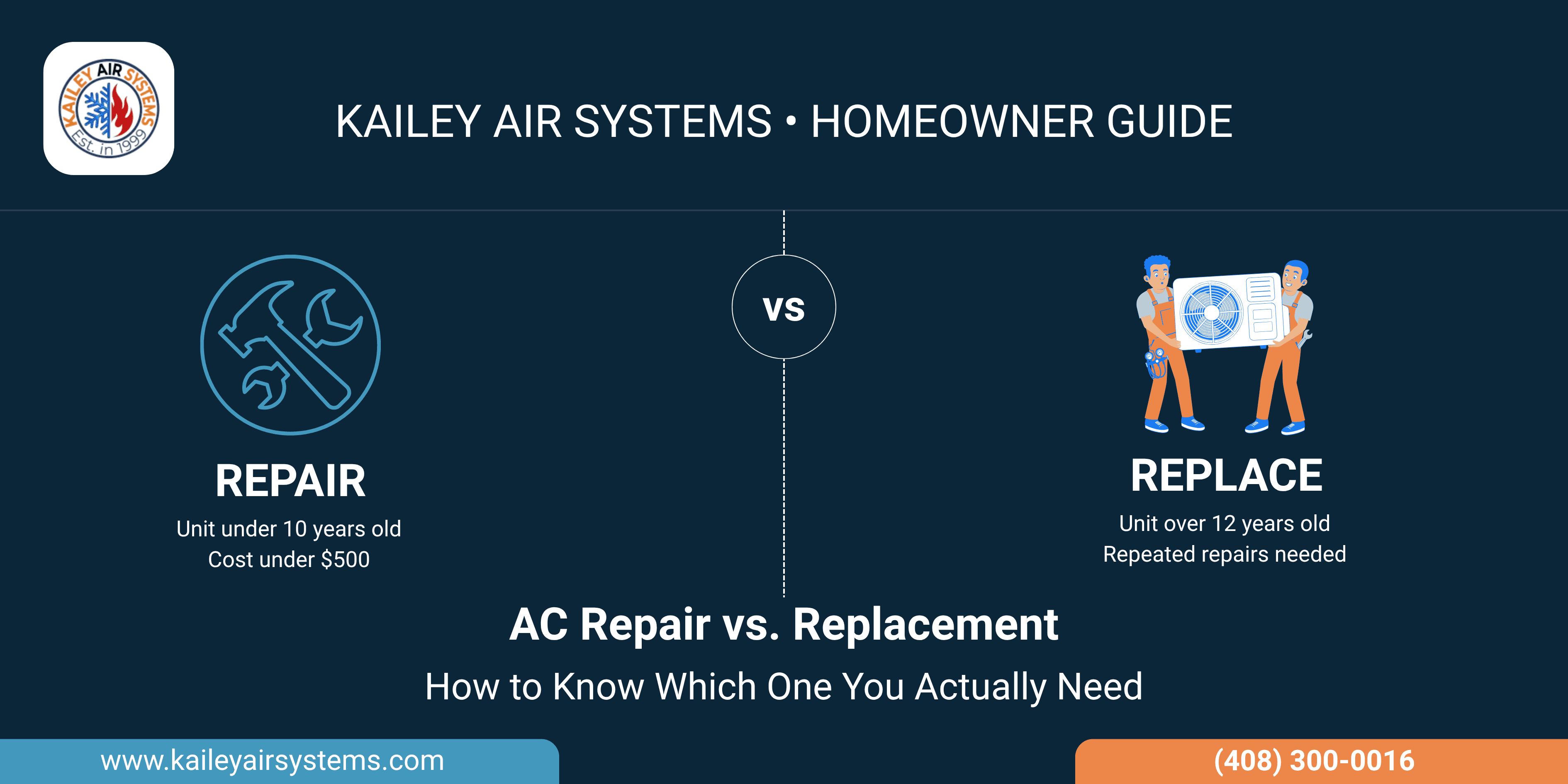
When your air conditioner stops cooling properly, one of the biggest questions homeowners face is whether to repair the existing system or replace it entirely. The right decision depends on several factors, including the age of your AC, repair history, energy efficiency, overall condition, and the cost of the recommended repair.
As a general guideline, repairing your AC may make sense when the system is relatively young, has been properly maintained, and needs an isolated repair. Replacement becomes more attractive when the system is older, requires frequent repairs, has become less efficient, or needs a major component such as a compressor.
Before making a decision, it is important to look at the complete picture rather than focusing only on the immediate repair cost.
The "$5,000 Rule" — A Simple Way to Decide
One commonly used HVAC rule of thumb is the "$5,000 Rule." It can provide a quick starting point when deciding whether repairing an older air conditioner is financially worthwhile.
The calculation is:
Age of AC system in years × Repair cost = Decision number
For example:
An 8-year-old AC with a $700 repair estimate: 8 × $700 = $5,600
A 4-year-old AC with a $400 repair estimate: 4 × $400 = $1,600
Under this rule of thumb, the first example would make replacement worth serious consideration, while repairing the second system may be the more practical choice.
However, the "$5,000 Rule" is only a guideline, not a fixed HVAC industry standard. The type of repair, condition of the equipment, energy efficiency, warranty coverage, and previous repair history should also be considered.
A professional HVAC inspection can help determine whether a repair is likely to extend the life of your system or whether replacement would provide better long-term value.
When Should You Repair Your AC?
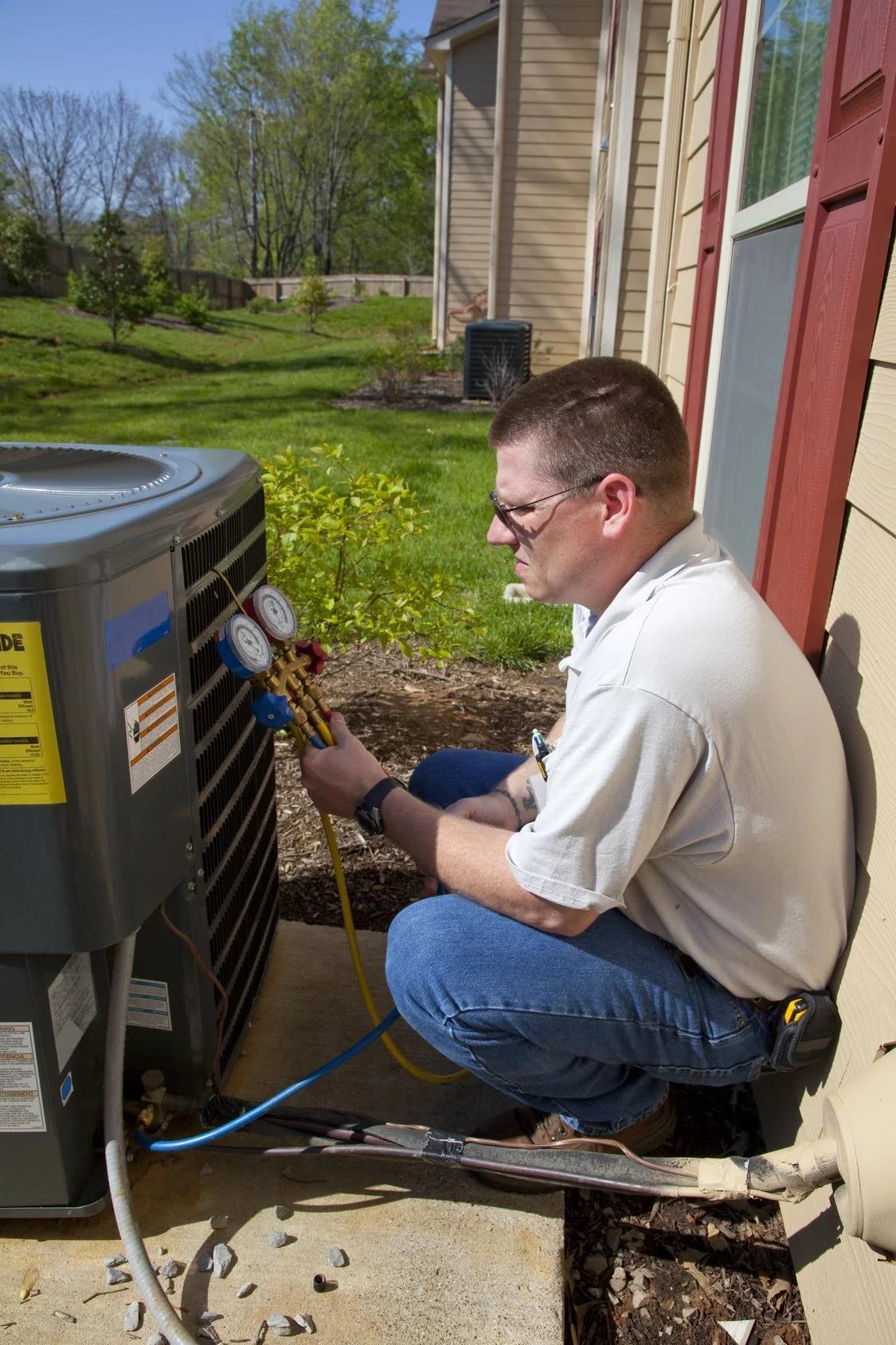
Repairing your air conditioner is often the better option when the system is relatively new and the problem is isolated.
AC repair may make sense when:
The system is still within its expected service life
This is the first significant repair the unit has required
The repair is relatively minor
The system has been properly maintained
The compressor and other major components are working properly
Your energy bills have remained relatively stable
The home is still cooling consistently
The repair is expected to provide additional reliable service life
Common AC problems include faulty capacitors, electrical connection issues, clogged filters, drainage problems, dirty coils, fan motor problems, and refrigerant-related issues.
The important factor is not simply the repair price. A repair on a newer, well-maintained AC may be a sensible investment, while the same repair on an older system with multiple previous breakdowns may not be worth the additional expense.
When Should You Replace Your AC?
AC replacement becomes more attractive when the system is older, unreliable, inefficient, or increasingly expensive to maintain.
You should consider getting a replacement estimate when:
Your AC is more than 10 years old
The system requires frequent repairs
Repair costs are becoming increasingly expensive
Your energy bills are rising without a major change in usage
The AC struggles to maintain the desired temperature
Some rooms remain significantly hotter or colder than others
The system frequently turns on and off
Indoor humidity remains uncomfortable
A major component such as the compressor has failed
Your system uses an older refrigerant such as R-22
An older AC does not automatically need to be replaced. A well-maintained system may continue operating effectively for years. However, when age is combined with frequent repairs, declining efficiency, or major component failure, replacing the system may make more financial sense.
What If Your AC Uses R-22 Refrigerant?
Some older air conditioning systems use R-22 refrigerant, also known as HCFC-22.
The production and import of new R-22 refrigerant in the United States ended in 2020. Existing R-22 systems can still be serviced using available reclaimed or previously produced refrigerant.
However, homeowners with older R-22 systems may face higher service costs when a refrigerant leak or major repair occurs. This is especially important if the system is already more than 10 years old.
R-22 alone does not mean that you must replace your AC. Instead, consider the refrigerant issue together with the system's age, repair history, efficiency, and overall condition.
If an older R-22 system develops a significant problem, comparing the cost of repair with a new AC installation can help you determine which option provides better long-term value.
How Much Does AC Replacement Cost?
The cost of replacing an air conditioner varies from one home to another. There is no single replacement price that applies to every property in the Bay Area.
The total cost can depend on several factors, including:
AC system size
Energy efficiency rating
Ductwork condition
Electrical requirements
Installation complexity
Indoor and outdoor unit configuration
Thermostat or control upgrades
Accessibility of the installation location
Existing HVAC system condition
Additional repairs required during installation
A properly sized AC system is also important. Choosing a system that is too large for your home does not necessarily mean better cooling. An oversized air conditioner can cycle too frequently and may not remove indoor humidity effectively.
That is why homeowners should get a professional assessment before choosing replacement equipment. A qualified HVAC contractor can evaluate the home, existing system, ductwork, and cooling requirements before recommending a new unit.
Does a New AC Actually Save Money?
A newer, properly installed high-efficiency air conditioner can use less energy than an older and inefficient system. However, the amount of money you save depends on several factors.
Your potential savings can be affected by:
The efficiency of your existing AC
The efficiency of the replacement system
How often you operate your AC
Your thermostat settings
Home insulation
Ductwork condition
Air leaks
Correct system sizing
Local electricity rates
Replacing an inefficient older system may reduce cooling energy use, but replacing the AC alone may not solve every efficiency problem.
For example, damaged or poorly sealed ductwork can cause conditioned air to escape before it reaches the rooms in your home. Insulation and airflow problems can also affect cooling performance.
For this reason, a complete HVAC assessment can be more useful than simply comparing the efficiency ratings of two air conditioning units.
Signs Your AC May Be Nearing the End of Its Life
Your air conditioner does not necessarily have to stop working completely before replacement becomes worth considering.
Here are some common signs that your AC may be approaching the end of its useful life.
1. Your AC Is More Than 10 Years Old
Age alone does not mean that your system needs to be replaced. However, older systems generally deserve closer evaluation, especially when they begin experiencing frequent problems.
If your AC is more than 10 years old and repair issues are becoming more common, it may be worthwhile to compare repair costs with the price of a new system.
2. Repairs Are Becoming More Frequent
One repair does not necessarily indicate that your AC is failing.
However, if you have had several service calls within a short period, multiple components may be reaching the end of their useful life.
Instead of continuing to pay for individual repairs, ask an HVAC professional whether replacement could provide better long-term reliability.
3. Your Energy Bills Are Increasing
If your cooling habits have not changed but your electricity bills continue to increase, declining AC efficiency may be one possible cause.
An older system may have to operate longer to achieve the same indoor temperature that a newer, properly sized system can maintain more efficiently.
4. Your Home Is Not Cooling Evenly
Uneven cooling is another common warning sign.
You may notice that:
One bedroom is always warmer than the others
The upstairs area is difficult to cool
Certain rooms never reach the thermostat setting
Some areas receive weak airflow
Uneven temperatures can be caused by the AC itself, but they can also result from ductwork, insulation, airflow, or sizing problems. A professional diagnosis can help identify the actual cause.
5. Your AC Constantly Cycles On and Off
If your AC repeatedly turns on and off more frequently than normal, there may be an issue with the thermostat, airflow, system sizing, or another component.
Frequent cycling can increase wear on the system and may affect both comfort and energy use.
6. Your Home Feels Too Humid
An air conditioner does more than lower temperature. It also helps control indoor humidity.
If your home continues to feel damp or uncomfortable even when the AC is running, the system may not be operating correctly or may not be properly sized for the property.
7. Your AC Makes Loud or Unusual Noises
Grinding, rattling, buzzing, squealing, or other unusual noises should not be ignored.
Some noises can indicate relatively minor problems, while others may point to motor, electrical, or mechanical issues.
Getting the problem diagnosed early can sometimes prevent a minor issue from developing into a more expensive repair.
Repair vs. Replace: Quick Comparison
Factor | Repair | Replace |
|---|---|---|
System age | Relatively newer system | Older system, especially 10+ years |
Repair history | First or occasional issue | Frequent breakdowns |
Problem | Minor or isolated failure | Major component or repeated failures |
Energy use | Still reasonably efficient | Efficiency has noticeably declined |
Comfort | Home cools consistently | Persistent hot or cold areas |
Upfront cost | Usually lower | Higher initial investment |
Long-term outlook | Good if system is otherwise healthy | Better when repair costs and inefficiency are increasing |
Warranty | Existing warranty may apply | New equipment warranty may apply |
This comparison is a general guide rather than a replacement for professional diagnosis.
For example, a newer AC with a major component failure may still be worth repairing, while an older system with a relatively minor repair may be approaching the point where replacement makes more financial sense.
Frequently Asked Questions
Is it cheaper to repair or replace an AC?
Repair is usually less expensive upfront. However, replacement may make more financial sense when the system is older, requires frequent repairs, or has become significantly less efficient.
The "$5,000 Rule" can provide a useful starting point, but the system's age, repair history, efficiency, and overall condition should also be considered.
How long does a residential AC unit last?
Many residential air conditioners can provide around 12–15 years of service, although actual lifespan varies depending on installation quality, maintenance, climate, usage, and equipment condition.
A system approaching or exceeding this age may be worth evaluating for replacement, especially if it has developed frequent repair problems.
What is usually the most expensive AC repair?
Major component failures, particularly compressor-related problems, can be among the most expensive AC repairs.
When a compressor or another major component fails on an older system, it is worth comparing the repair estimate with the cost and benefits of installing a new AC system.
Does an R-22 AC need to be replaced?
Not necessarily. Existing R-22 systems can still be serviced using available reclaimed or previously produced refrigerant.
However, an older R-22 system with a significant refrigerant leak or major repair may be a good candidate for replacement because new R-22 production and imports ended in the United States in 2020.
Should I repair my 10-year-old AC or replace it?
It depends on the condition of the system and the type of repair required.
If your 10-year-old AC needs a relatively minor repair and has otherwise performed reliably, repairing it may be reasonable. If it has frequent breakdowns, increasing energy costs, or a major component failure, replacement deserves serious consideration.
Can I finance a new AC system?
Many HVAC companies offer financing options for qualified customers. Depending on the company and financing program, homeowners may be able to spread the cost of a new air conditioning system across monthly payments.
If you are considering replacement, ask your HVAC contractor about available financing options and the terms that apply to your installation.
Repair or Replace: Making the Right Choice
There is no single rule that determines whether every air conditioner should be repaired or replaced. The right decision depends on your AC system's age, repair history, efficiency, overall condition, and the cost of the recommended repair.
If your AC is relatively new and needs an isolated repair, fixing it may be the most practical option. However, if the system is more than 10 years old, requires frequent repairs, has increasing operating costs, or needs a major component replacement, installing a new system may provide better long-term value.
Before making a decision, have a qualified HVAC professional inspect the system and explain both options. A proper diagnosis can help you understand not only what has failed, but also whether the rest of the system is likely to provide reliable performance after the repair.
Get Expert Help With Your AC Repair or Replacement
Not sure whether you should repair your existing AC or invest in a new system? Kailey Air Systems can evaluate your current system and help you understand your repair and replacement options.
Whether you need AC repair, AC replacement, or a new air conditioning installation in San Jose, getting a professional assessment can help you make a more informed decision.
Call Kailey Air Systems at (408) 300-0016 or request an estimate today.